If you've spent any time building distributed systems, you've probably felt the pain of the monolithic API chain.
Service A needs to tell Service B that a user signed up. Service B needs to tell Service C to send an email, and Service D to provision a workspace. You write a series of HTTP REST calls. It works perfectly on your local machine. It works perfectly in staging.
Then Black Friday hits, Service D goes down for five minutes, the HTTP calls from A to D start timing out, connection pools exhaust, and suddenly your entire signup flow is broken because a background provisioning task failed.
This is the fragility of synchronous coupling. And it is exactly the problem Event-Driven Architecture (EDA) solves.
Thinking in Events
In a traditional request-driven model, services command each other to do things: “Hey Email Service, send this welcome email.”
In an event-driven model, services simply state facts about what happened in the past: “Hey everyone, a user just signed up.”
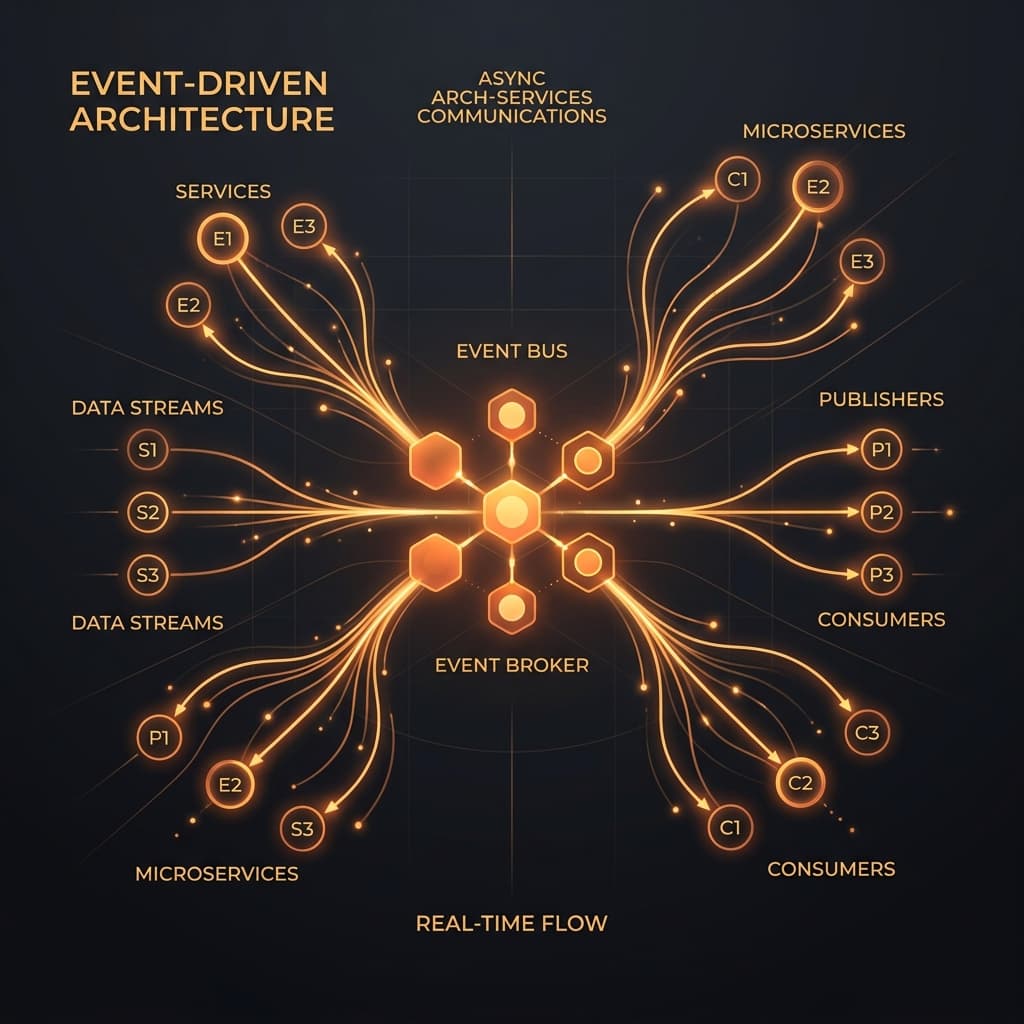
This semantic shift is profound. The service emitting the event (the Producer) doesn't know, and doesn't care, who is listening. The services reacting to the event (the Consumers) don't need to know who produced it, they just care that it happened.
This concept is often called choreography (as opposed to orchestration). Instead of a central conductor telling every musician what to play and when, each musician just listens to the music and joins in at the right time.
The Core Components
An EDA system typically relies on three main pillars:
1. The Producer
The source of the event. This could be an API gateway, a database change data capture (CDC) stream, or a microservice. Its only job is to publish the event to the broker and immediately move on.
2. The Event Broker
The nervous system of your architecture. This is where tools like Apache Kafka, RabbitMQ, or AWS EventBridge live. The broker ensures the event is safely stored, routed, and delivered.
Brokers generally come in two flavors:
- Message Queues (RabbitMQ, SQS): Designed for point-to-point delivery. Once a message is consumed, it's typically gone. Great for task distribution (e.g., worker pools).
- Event Logs/Streams (Kafka, Kinesis): Designed as an append-only log. Events are stored for a retention period and can be read by multiple independent consumers at their own pace.
3. The Consumer
The service that listens to the broker. When an event of interest arrives, the consumer wakes up, does its job (updates a database, sends an email, invalidates a cache), and optionally emits new events.
Why Bother? (The Good)
Moving to EDA is not a casual decision, but the benefits for scale are massive:
1. Ultimate Decoupling: You can add a completely new feature (e.g., a real-time analytics dashboard) simply by having a new service listen to existing events. You don't need to touch the legacy monolith that emits them.
2. Resilience: If the Email Service goes down, the broker just holds onto the "User Signed Up" events. When the Email Service recovers, it picks up right where it left off. No data lost, no upstream cascading failures.
3. Spiky Traffic Absorption: The broker acts as a shock absorber. If a burst of traffic hits, the events pile up in the queue. Consumers process them at their maximum safe rate without getting overwhelmed or OOM-killed.
The Hangover (The Bad)
I won't lie to you: EDA introduces significant complexity. If you're building a simple CRUD app, stay away.
Eventual Consistency: Your database reads might be stale for a few milliseconds (or seconds, if the queue is backed up). Your UI needs to be designed to handle this gracefully (e.g., optimistic UI updates).
Observability is Hard: "Why didn't the user get their email?" In a REST architecture, you check the logs of the single API request. In EDA, you have to trace an event across a distributed broker, multiple topics, and asynchronous consumers. Distributed tracing (OpenTelemetry) goes from "nice to have" to "absolutely mandatory".
The Two-Phase Commit Problem: How do you guarantee that you save data to your database and publish the event to Kafka without one failing and leaving your system in an inconsistent state? You usually need patterns like the Outbox Pattern, where you save the event to the same database in the same transaction, and a separate process forwards it to the broker.
The Verdict
Event-Driven Architecture is not a silver bullet. It trades temporal coupling (services needing to be up at the same time) for structural complexity.
But as your engineering organization scales, and as your system grows from a handful of services to dozens or hundreds, the autonomy that EDA provides to individual teams becomes its killer feature. You stop building tight webs of dependencies, and start building independent systems that just happen to communicate through a shared river of facts.